Best AI Visibility Tools in 2026
Compare the best AI visibility tools in 2026 by platform coverage, reporting depth, optimization workflows, pricing transparency, and team fit.

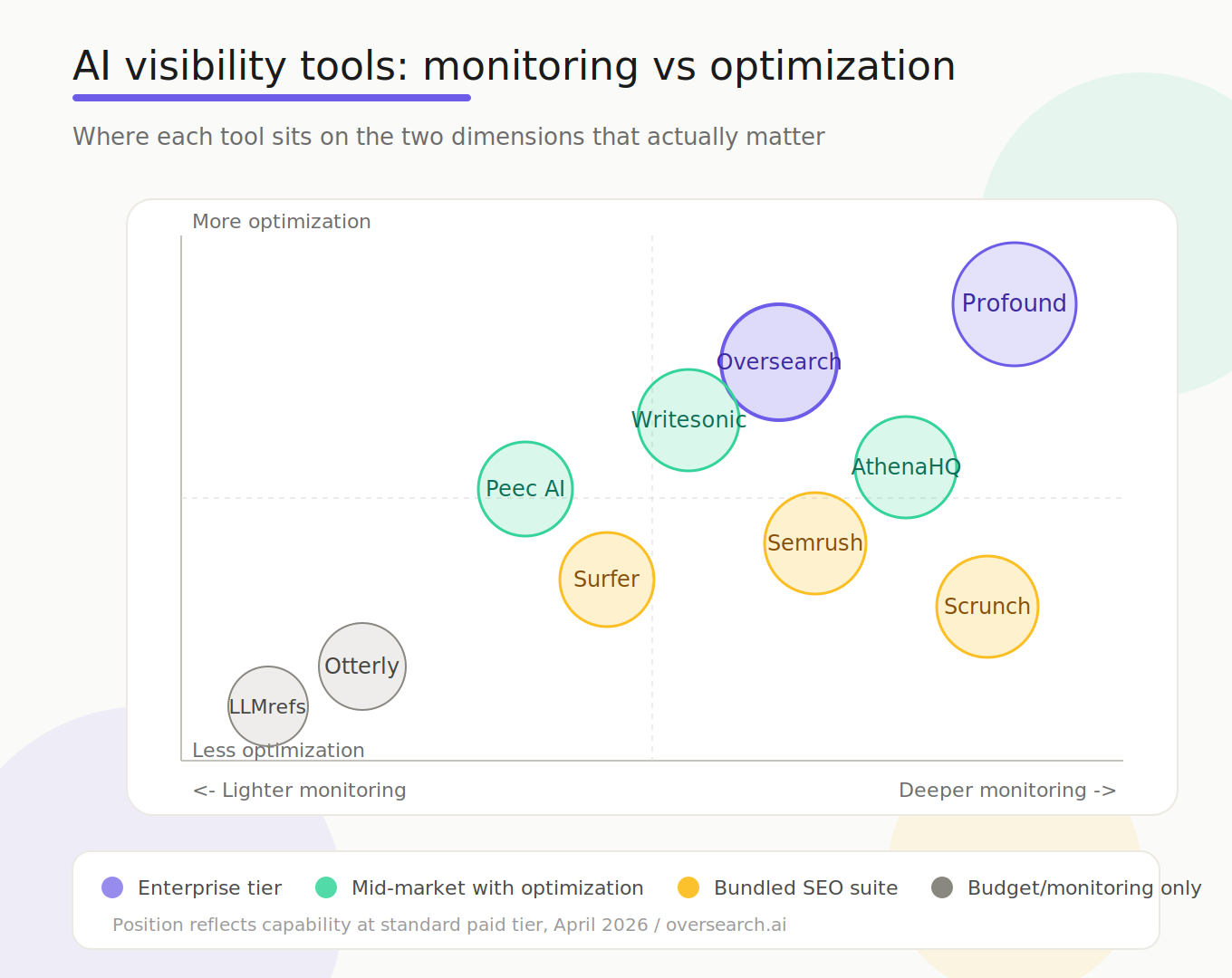
The best AI visibility tool depends on your team size, workflow needs, and whether you want passive monitoring or actionable optimization. For enterprises, Profound. For mid-market teams that want tracking plus next steps, Oversearch. For agencies, Peec AI. For low-cost validation, Otterly.AI. If you already use Semrush or Surfer, test the add-on path first. AI visibility tools fill the measurement gap between traditional SEO platforms and the AI answer layer that now sits above or beside the classic SERP.
Jump to section
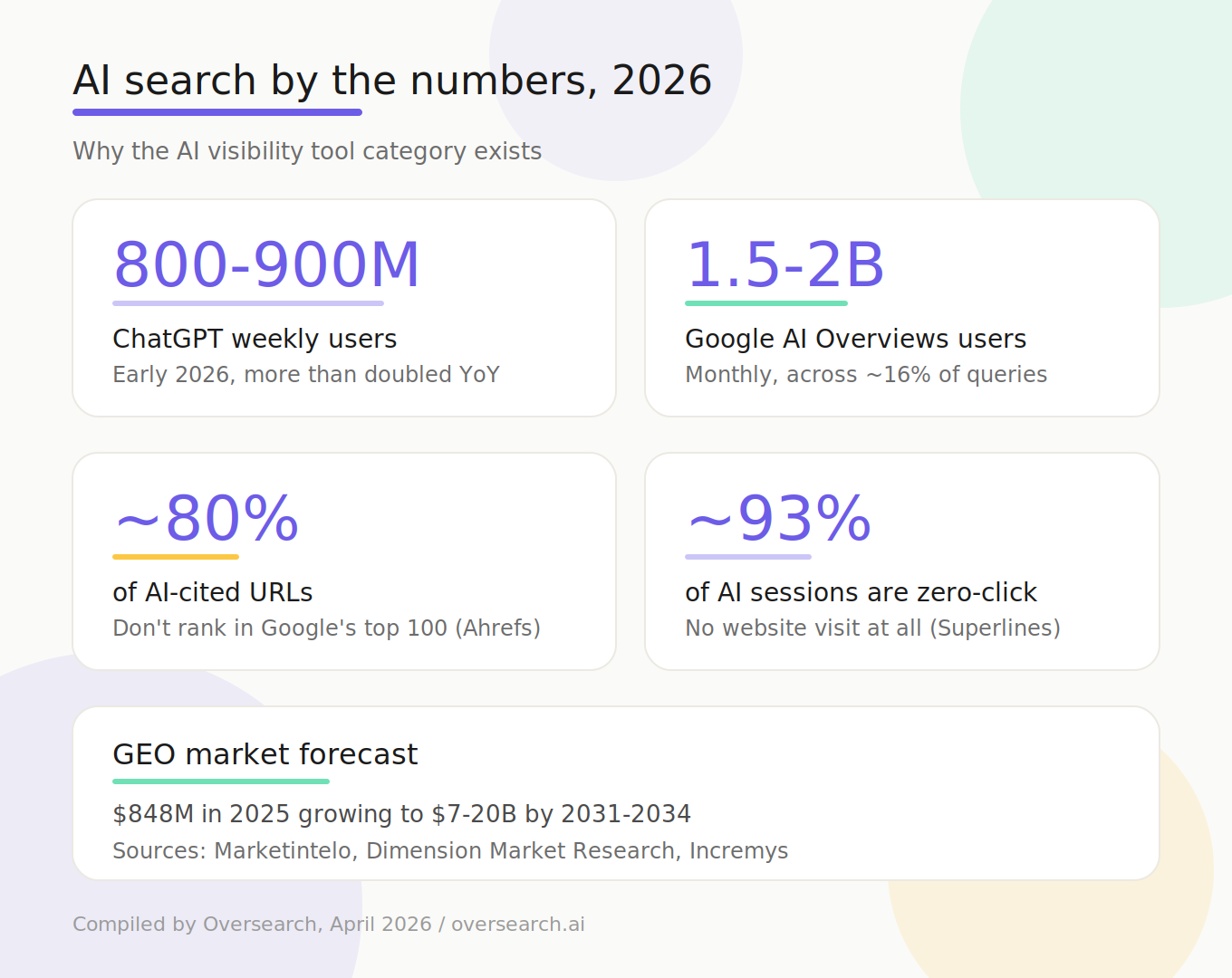
Your buyers can now discover, compare, and shortlist vendors inside ChatGPT, Google AI Overviews, Perplexity, and Gemini before they ever visit your site. That has created a new category of software: AI visibility tools. OpenAI says ChatGPT now has more than 900 million weekly active users, which helps explain why AI discovery has become hard to ignore.
These tools track whether your brand is mentioned or cited in AI-generated answers, which competitors appear alongside you, and which pages or third-party sources seem to influence that visibility. They are not a replacement for SEO platforms, but they do fill a real measurement gap. Ahrefs found that only 12% of cited URLs from major AI assistants appear in Google's top 10 for the same query, and in newer AI Overviews research, just 38% of cited pages also rank in Google's top 10.
Disclosure: Oversearch is included in this comparison because it competes in this category. This page is editorial content and is not legal, financial, or procurement advice. Tools are assessed using consistent criteria, but pricing, features, and platform coverage can change over time.
Quick picks
| Use case | Best pick |
|---|---|
| Enterprises | Profound |
| Mid-market teams | Oversearch |
| Agencies | Peec AI |
| Low-cost option | Otterly.AI |
| Already using Semrush | Semrush AI Visibility Toolkit |
| Already using Surfer | Surfer AI Tracker |
| Tool | Starting price | Best for | Pricing model |
|---|---|---|---|
| Profound | Custom | Enterprise teams | Custom pricing |
| Peec AI | From €89/mo | Agencies and marketing teams | Public pricing |
| Oversearch | From $39/mo | Mid-market teams and agencies | Platform pricing |
| Semrush AI Visibility Toolkit | $99/mo | Existing Semrush users | Public pricing |
| AthenaHQ | Self-serve + custom | Teams wanting workflow depth | Public pricing structure |
| Otterly.AI | $29/mo | Solo operators and small teams | Public pricing |
| Writesonic GEO | $99/mo | Content-heavy teams | Public pricing |
| Surfer AI Tracker | Included in plans | Existing Surfer users | Public pricing |
| Scrunch AI | $250/mo | Growing brands | Public pricing |
Pricing and feature note: Pricing, feature availability, supported AI platforms, and plan structure may change. Always verify current details on the vendor's official site before making a purchase decision.
Why AI visibility tools matter
AI visibility is not the same thing as organic ranking. A brand can rank well in Google and still be missing, misrepresented, or weakly cited in AI-generated answers. That matters because AI answer engines are becoming a meaningful layer of product discovery, comparison, and shortlist formation. Semrush says AI Overviews now appear on about 16% of searches, while Ahrefs' research shows the overlap between AI citations and traditional rankings is far from clean.
That is why this category exists. Traditional SEO tools tell you where you rank. AI visibility tools tell you whether you are being surfaced, cited, and described in the answer layer that sits above or beside the classic SERP. Those are related jobs, but they are not the same job.
How these tools were evaluated
This guide compares tools across five dimensions.
How this page was built: This comparison is based on publicly available product information, editorial review, and hands-on familiarity where applicable. Inclusion, ordering, or category placement does not imply certification, formal endorsement, or guaranteed results.
Platform coverage
Does the tool track the AI platforms that matter most in practice, such as ChatGPT, Google AI Overviews, Perplexity, and Gemini?
Reporting depth
Does it surface mentions, citations, competitive presence, and prompt-level visibility in a way a team can actually use?
Optimization workflow
Does it help users act on the data through recommendations, source discovery, audits, or prioritization?
Pricing clarity
Can a buyer understand likely cost without sitting through a sales process?
Buyer fit
Is the product realistically suited to enterprises, agencies, mid-market teams, or smaller operators?
Profound
Best for: enterprises and larger brands that need a procurement-friendly platform and can live with custom pricing
Profound is one of the strongest enterprise-facing products in this category. Its positioning is squarely aimed at larger brands that need AI search visibility, control, and reporting depth, and its official pricing page is structured around customized plans rather than self-serve entry. That alone tells you a lot about who the product is built for.
Strengths
- Strong enterprise positioning
- Broad AI visibility focus
- Good fit for larger teams that expect vendor-led onboarding
Limitations
- Pricing is not especially transparent for smaller buyers
- Less attractive if you want a lightweight self-serve workflow
Peec AI
Best for: agencies and marketing teams that want a specialist AI visibility product with accessible pricing and a cleaner learning curve
Peec has become one of the more visible specialist tools in AI search analytics. Its official pricing is public, and the product is positioned around tracking AI search performance, competitor visibility, and prompt-level monitoring for marketing teams. Public pricing starts at the lower end of the category, which makes it easier to trial than enterprise-led alternatives.
Strengths
- Public pricing
- Clear AI-search-first positioning
- Good fit for agencies and teams that want a focused tool rather than a large suite
Limitations
- Less of a broad SEO platform play
- Buyers should validate whether the workflow depth is enough for page-level execution
Oversearch
Best for: mid-market teams and agencies that want visibility tracking and practical next steps in the same workflow
Oversearch is built around AI visibility tracking plus optimization workflows. It is strongest when the team does not just want to measure mentions and citations, but also wants help understanding why competitors are surfacing and what to change next across owned content and off-site sources. For teams that want to analyze competitor AI visibility systematically, the workflow connects tracking data to prioritized actions.
Strengths
- Combines tracking with optimization workflows
- Useful for competitor benchmarking and citation-gap analysis
- Good fit for mid-market B2B teams and agencies
Limitations
- More specialized than a broad all-in-one SEO suite
- Best fit is teams that care about actionability, not just passive monitoring
Semrush AI Visibility Toolkit
Best for: teams already using Semrush that want AI visibility without adding another specialist platform too early
Semrush offers AI visibility as a paid toolkit, with official Semrush documentation listing the AI Visibility Toolkit at $99 per month. That makes it especially relevant for teams that already live inside Semrush and would rather extend an existing stack than add another standalone vendor. Semrush's own materials say the toolkit covers prompt tracking, brand performance analysis, and AI search checks.
Strengths
- Familiar environment for existing Semrush users
- Public pricing for the AI toolkit
- Good reporting convenience if your team already uses Semrush daily
Limitations
- Best value usually comes when you are already in the Semrush ecosystem
- Less compelling as a standalone choice if AI visibility is your only priority
AthenaHQ
Best for: teams that want a specialist AI search platform with stronger workflow orientation than entry-level trackers
AthenaHQ positions itself as an AEO and GEO platform for AI search and has an official plans page with both self-serve and custom options. The product leans more into workflow and analysis than bare-bones monitoring, which is useful for teams that want more than a dashboard.
Strengths
- More action-oriented than simple mention tracking
- Built specifically around AEO and GEO workflows
- Public plan structure exists
Limitations
- Still a more niche product than suite-based options
- Buyers should validate pricing and credit logic against their actual monitoring volume
Otterly.AI
Best for: solo operators, consultants, and small teams that want a simple and affordable starting point
Otterly remains one of the easiest low-cost entry points in the category. Its official pricing page starts at $29 per month, and the product is positioned very clearly around prompt monitoring across AI Overviews, ChatGPT, Perplexity, and related platforms. It also supports daily tracking on higher plans.
Strengths
- Low entry price
- Public pricing
- Straightforward way to validate whether AI visibility is a real issue for your brand
Limitations
- Lower-tier plans are naturally narrower in depth and capacity
- Better as an early-stage tracking tool than as a full optimization system
Writesonic GEO
Best for: content-led marketing teams that want SEO, GEO, and AI-assisted production in one environment
Writesonic now packages GEO and AI search visibility into its pricing structure, with official pricing that starts at $99 per month and more serious AI search functionality from higher tiers upward. Its GEO positioning is strongest for teams that also want AI-assisted content production in the same stack.
Strengths
- Combines AI content workflows with GEO
- Public pricing
- Useful for content-heavy teams that want fewer separate tools
Limitations
- May be less attractive if you already have your content stack elsewhere
- Buyers should separate "visibility tooling" needs from "AI writing platform" needs
Surfer AI Tracker
Best for: content and SEO teams already invested in Surfer who want AI tracking inside the same operating system
Surfer now frames its platform around winning visibility in AI search, and its official pricing page says AI visibility tracking is included in relevant plans, with weekly refreshes and prompt tracking. That makes it a logical extension for teams already using Surfer for content optimization.
Strengths
- Natural fit for existing Surfer users
- Brings AI visibility into an established content optimization workflow
- Public pricing
Limitations
- Best value depends on whether you already rely on Surfer
- Not the clearest choice if you only want AI visibility and nothing else
Scrunch AI
Best for: brands that want something more capable than entry-level monitoring without jumping straight to enterprise-style procurement
Scrunch is more transparent on pricing than some buyers may expect. Its official pricing pages show a Core plan for brands starting at $250 per month, with custom enterprise pricing above that. The product appears to lean into AI presence growth and site-audit-supported workflows rather than bare monitoring alone.
Strengths
- Public starting price
- More substantive than a pure budget tracker
- Appears oriented toward growing brands as well as enterprise buyers
Limitations
- Higher starting point than low-cost entrants
- Buyers should confirm how much workflow depth they need before paying more
Which AI visibility tool should you choose?
If you are buying for an enterprise and vendor fit matters as much as features, Profound is one of the cleanest shortlists to start with. Its positioning, pricing model, and enterprise-facing presentation all point in that direction.
If you are a mid-market team that needs monitoring plus actionability, the better choices are usually the products that do more than track mentions. That is where Oversearch and AthenaHQ make more sense than a basic dashboard. If you are an agency, Peec is easy to justify because it is focused, comparatively accessible, and clearly built for AI search analytics rather than broad-suite sprawl.
If you already use Semrush or Surfer heavily, the smart move is usually to test the add-on path first. The standalone specialist may still be better in the end, but the switching cost is lower when you start with the platform you already trust. Semrush's AI Visibility Toolkit is publicly priced at $99 per month, while Surfer has already made AI visibility part of its product story and pricing structure.
If budget is tight and the goal is simply to prove the problem exists, Otterly is the easiest place to start. At $29 per month, it is one of the lowest-friction ways to begin tracking prompt-level visibility without forcing a big software decision too early.
For a narrower comparison focused specifically on ChatGPT, see the ChatGPT visibility tools guide. Teams exploring whether to hire outside help may also want to review ChatGPT visibility services and what to look for in a provider.
What these tools still do not do well
This category is improving fast, but most tools still have blind spots. Many can tell you whether you were mentioned or cited, but fewer can reliably explain why you were omitted, whether the answer was inaccurate, or which content changes are most likely to move the needle. That is one reason actionability is still a more useful comparison lens than raw platform count.
Closed-loop attribution is also immature. Most vendors can help you monitor AI visibility. Fewer can connect that visibility cleanly to pipeline, revenue, or downstream branded demand without extra internal measurement work. That is not a reason to ignore the category. It just means buyers should be realistic about what they are purchasing today.
FAQ
What is the difference between an AI visibility tool and an SEO tool?
An SEO tool tracks rankings, keywords, backlinks, and technical performance in traditional search. An AI visibility tool tracks whether your brand is mentioned or cited inside AI-generated answers and how that presence compares with competitors. The two are related, but they do not answer the same question. Ahrefs' research is a good example of why: AI-cited URLs often do not line up neatly with top-ranking pages in Google.
Do I need a dedicated AI visibility tool, or is an SEO suite add-on enough?
That depends on how serious the use case is. If you already use Semrush or Surfer heavily, starting with the built-in or add-on route is sensible. If AI visibility is becoming a real operating metric rather than a side report, a specialist platform will usually give you more depth and a better workflow.
Which AI platforms matter most to track?
For most B2B teams, ChatGPT, Google AI Overviews, Perplexity, and Gemini are the most practical starting set. They cover the answer engines that most often come up in actual discovery and comparison workflows, and they are the platforms most commonly supported across the tools compared here.
How many prompts should a typical B2B team track?
There is no universal number, but most teams do better with a focused set than with prompt sprawl. A controlled group of high-intent prompts across category, comparison, alternatives, and recommendation use cases is usually more useful than trying to track everything. The right number depends on product breadth, market complexity, and how often your team can actually act on what it learns.
What should I compare before buying an AI visibility tool?
Focus on five things: platform coverage, reporting depth, actionability, pricing clarity, and buyer fit. A tool with broader engine coverage is not automatically better if the workflow stops at reporting. In practice, most teams get more value from a product that helps them decide what to fix next.
References
- Profound - Enterprise AI visibility platform. Custom enterprise pricing.
- Peec AI - Specialist AI search analytics with public pricing.
- Oversearch - AI visibility tracking with optimization workflows for mid-market teams and agencies.
- Semrush AI Visibility Toolkit - AI visibility add-on for the Semrush ecosystem. Listed at $99/month.
- AthenaHQ - AEO and GEO platform for AI search with public plans.
- Otterly.AI - Affordable multi-engine AI visibility monitoring. From $29/month.
- Writesonic - GEO and AI-assisted content production platform. From $99/month.
- Surfer - Content optimization platform with AI visibility tracking included.
- Scrunch AI - AI presence growth platform. Core plan from $250/month.
This guide reflects editorial judgment based on information available at the time of review. Readers should confirm current pricing, features, and fit directly with each vendor before purchasing.
Ready to improve your AI visibility?
Track how AI search engines mention and cite your brand. See where you stand and identify opportunities.